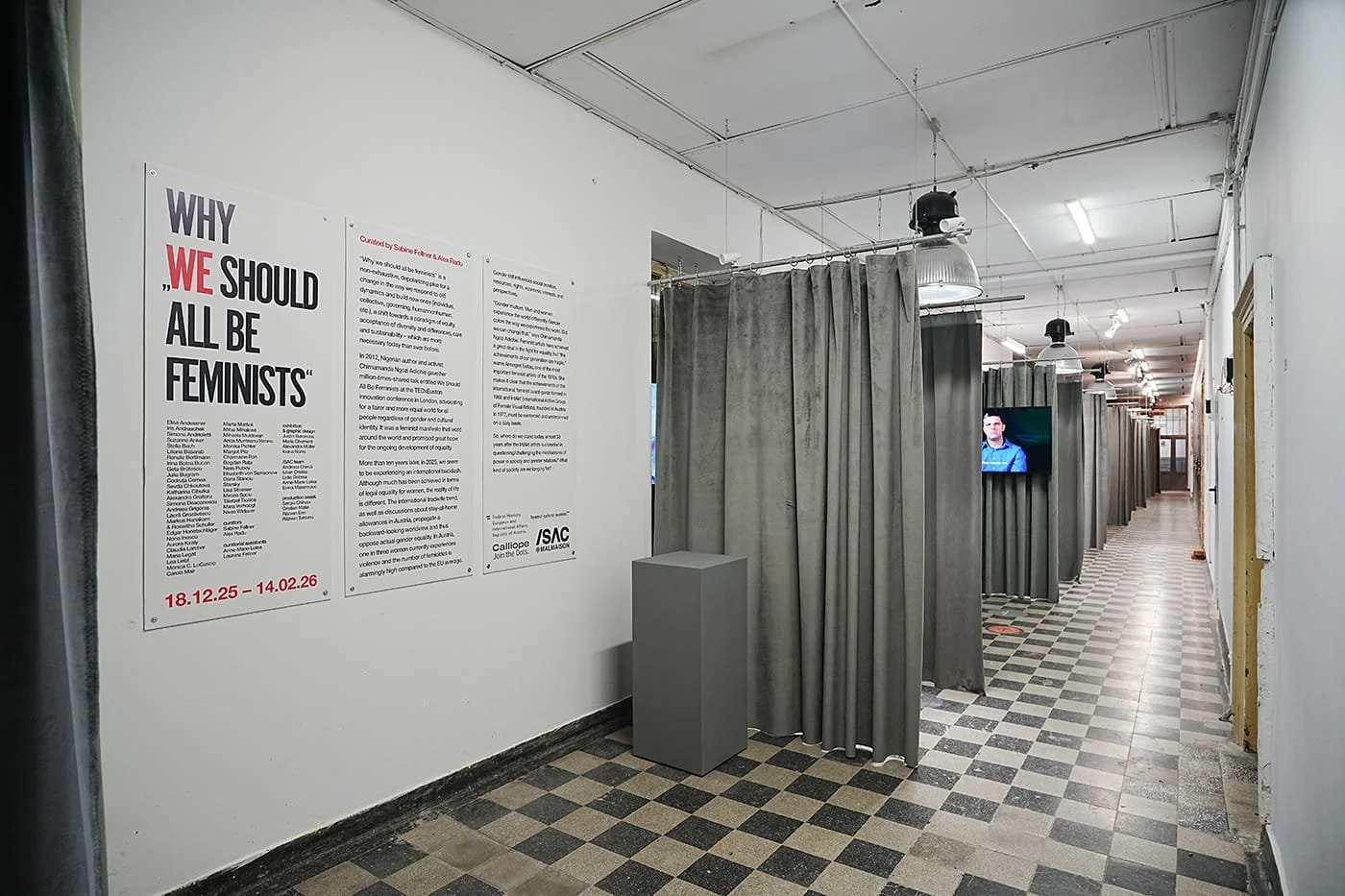
Why we should all be feminists
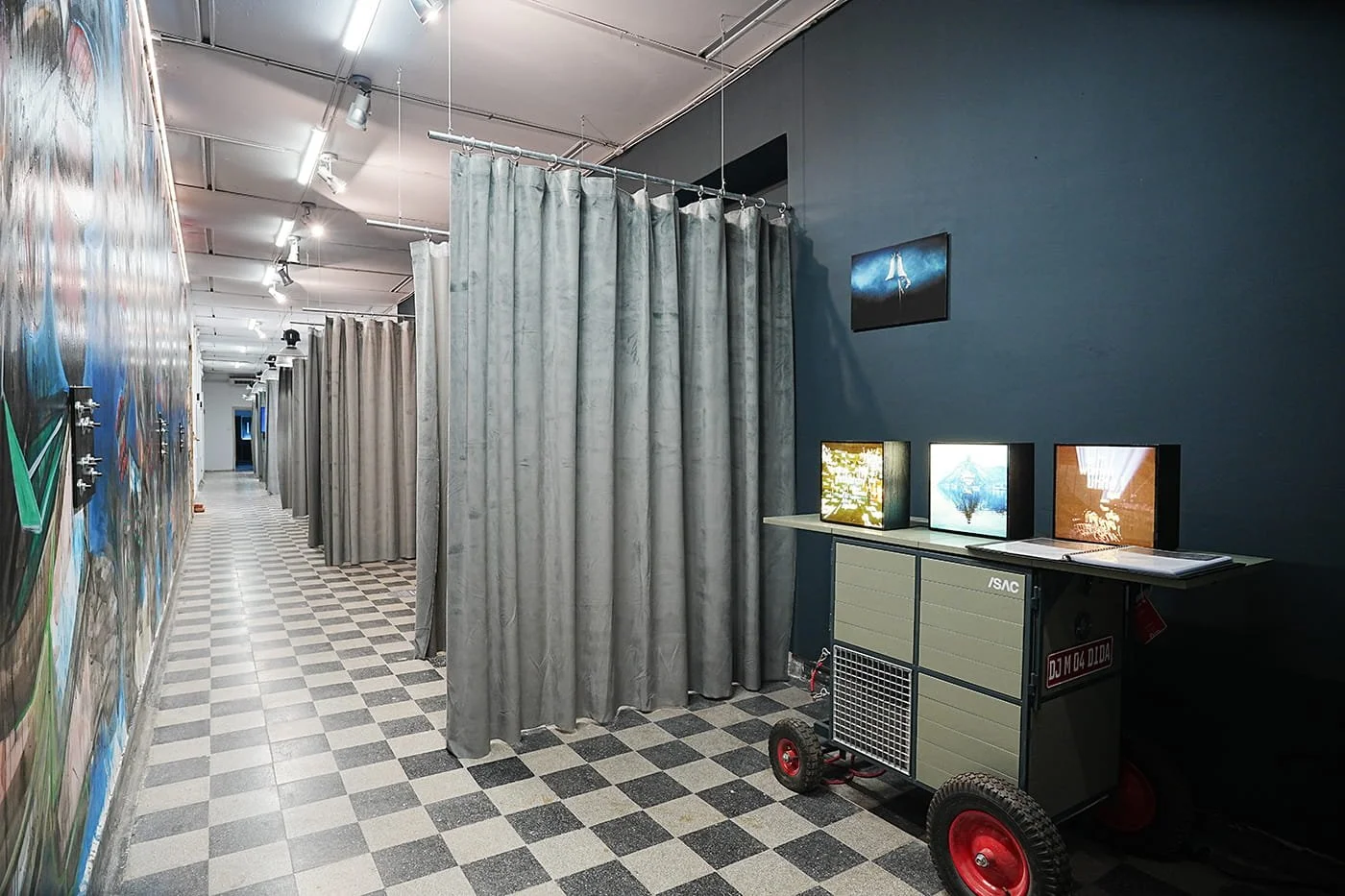
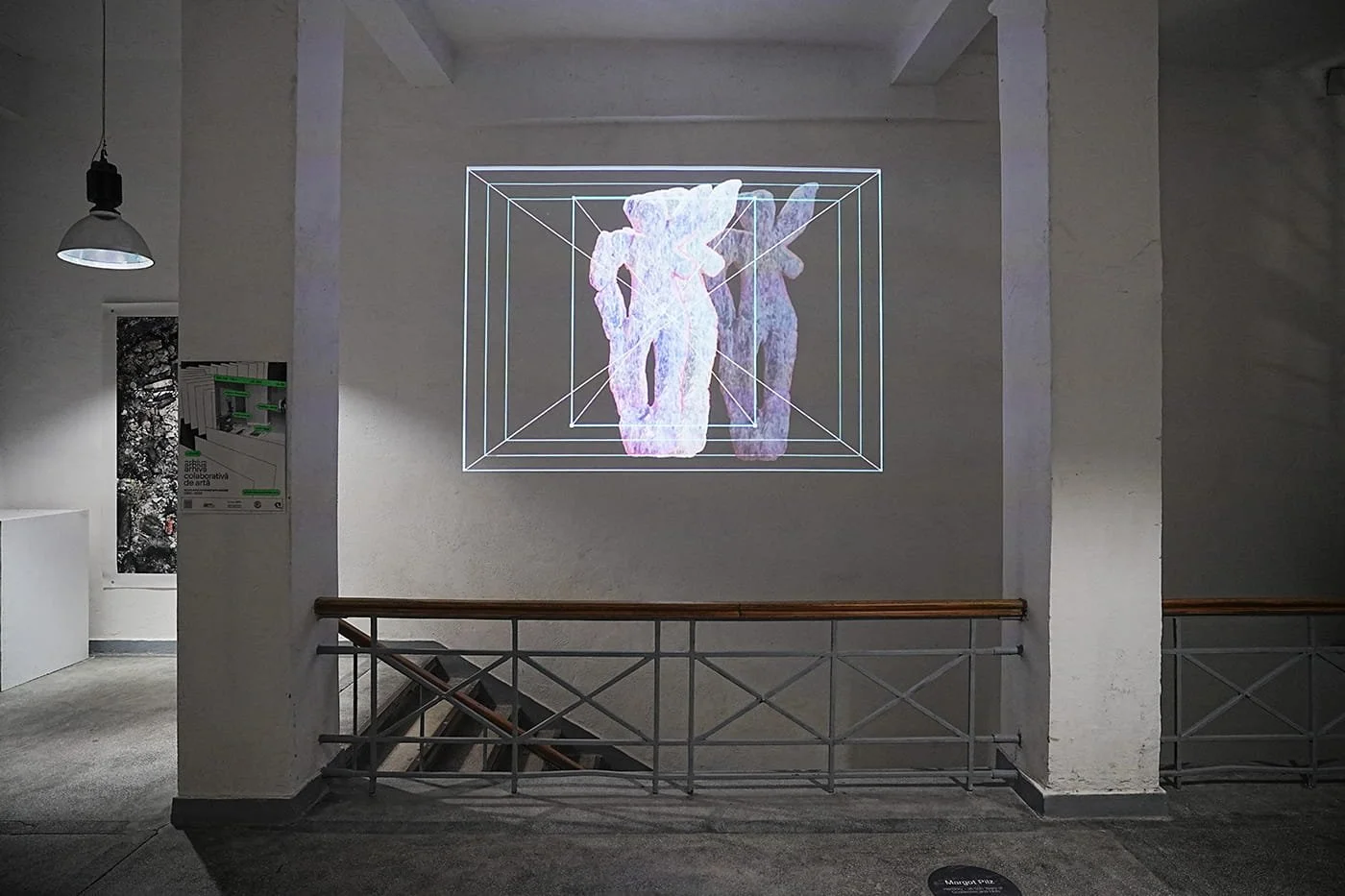
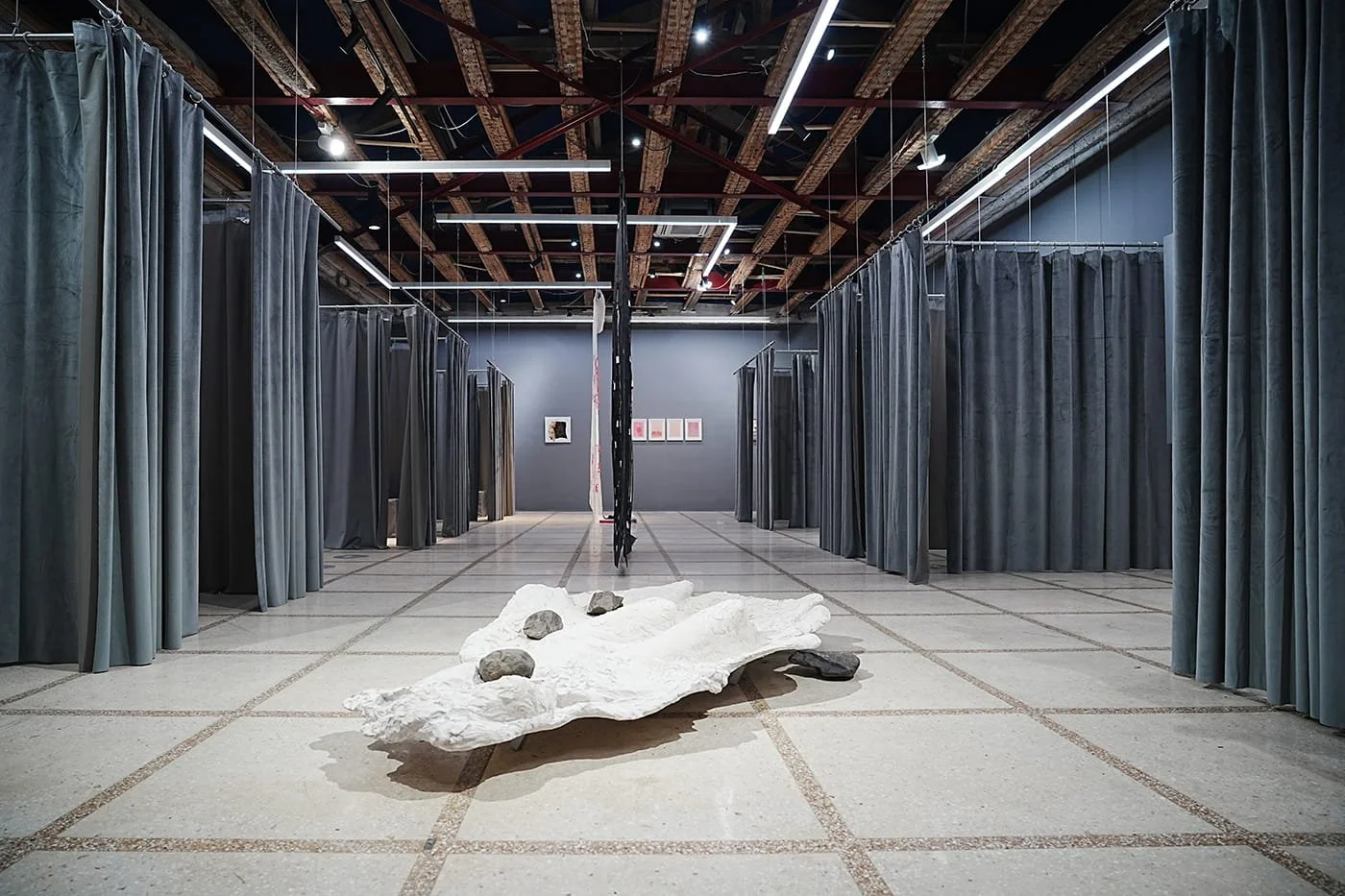
/SAC @ MALMAISON, Bucharest
18.12.2025-14.02.2026
curated by Sabine Fellner & Alex Radu
exhibition & graphic design: Justin Baroncea, Maria Ghement, Alexandra Muller, Ioana Naniș
curatorial assistance: Anne-Marie Lolea & Laurenz Fellner
/SAC team: Andreea Chircă, Iulian Cristea, Lidia Dobrea, Anne-Marie Lolea, Elena Maxemciuc
artists: Elisa Andessner, Iris Andraschek, Simona Andrioletti, Suzanne Anker, Stella Bach, Liliana Basarab, Renate Bertlmann, Irina Botea Bucan, Geta Brătescu, Julia Bugram, Codruța Cernea, Sevda Chkoutova, Katharina Cibulka, Alexandra Croitoru, Simona Deaconescu, Andreea Grigoraș, Lăcră Grozăvescu, Markus Hanakam & Roswitha Schuller, Edgar Honetschläger, Nona Inescu, Aurora Kiraly, Claudia Larcher, Maria Legat, Lea Liebl, Monica C. LoCascio, Carola Mair, Marta Mattioli, Mihai Mihalcea, Mihaela Moldovan, Anca Munteanu Rimnic, Monika Pichler, Margot Pilz, Charmaine Poh, Bogdan Rața, Ness Rubey, Elisabeth von Samsonow, Oana Stanciu, Starsky, Lisa Strasser, Mircea Suciu, Tăietzel Ticălos, Mara Verhoogt, Nives Widauer
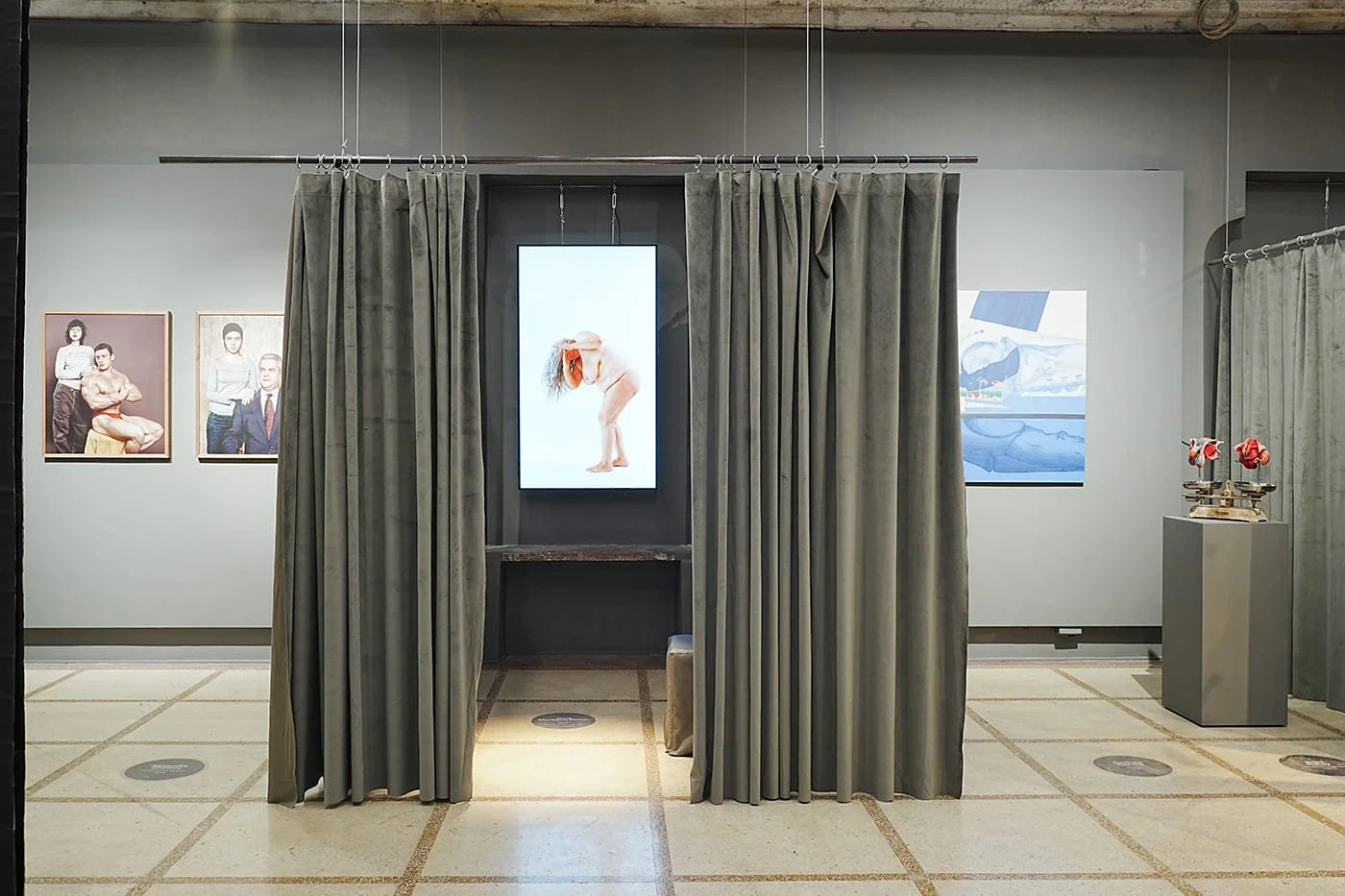
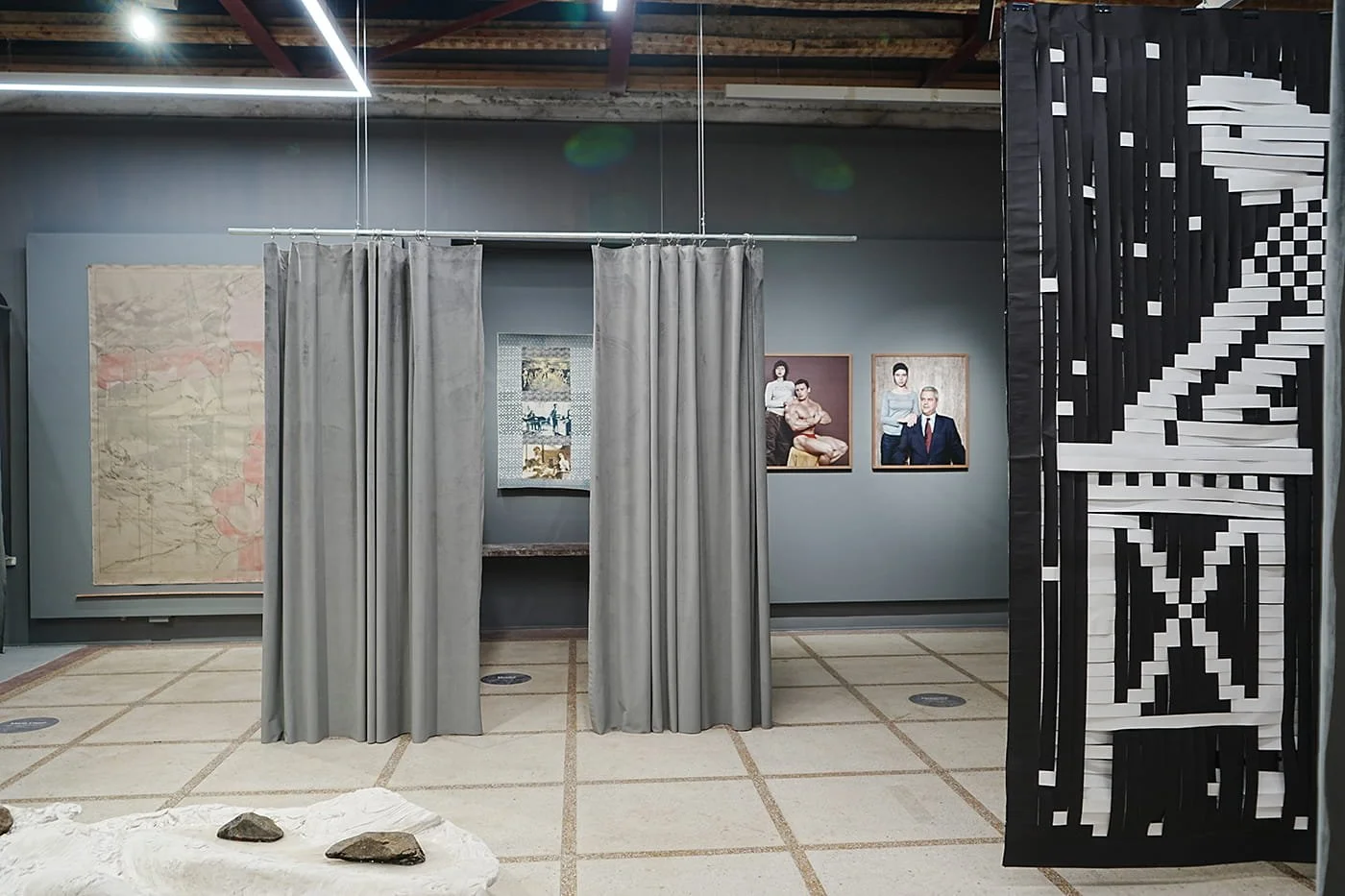
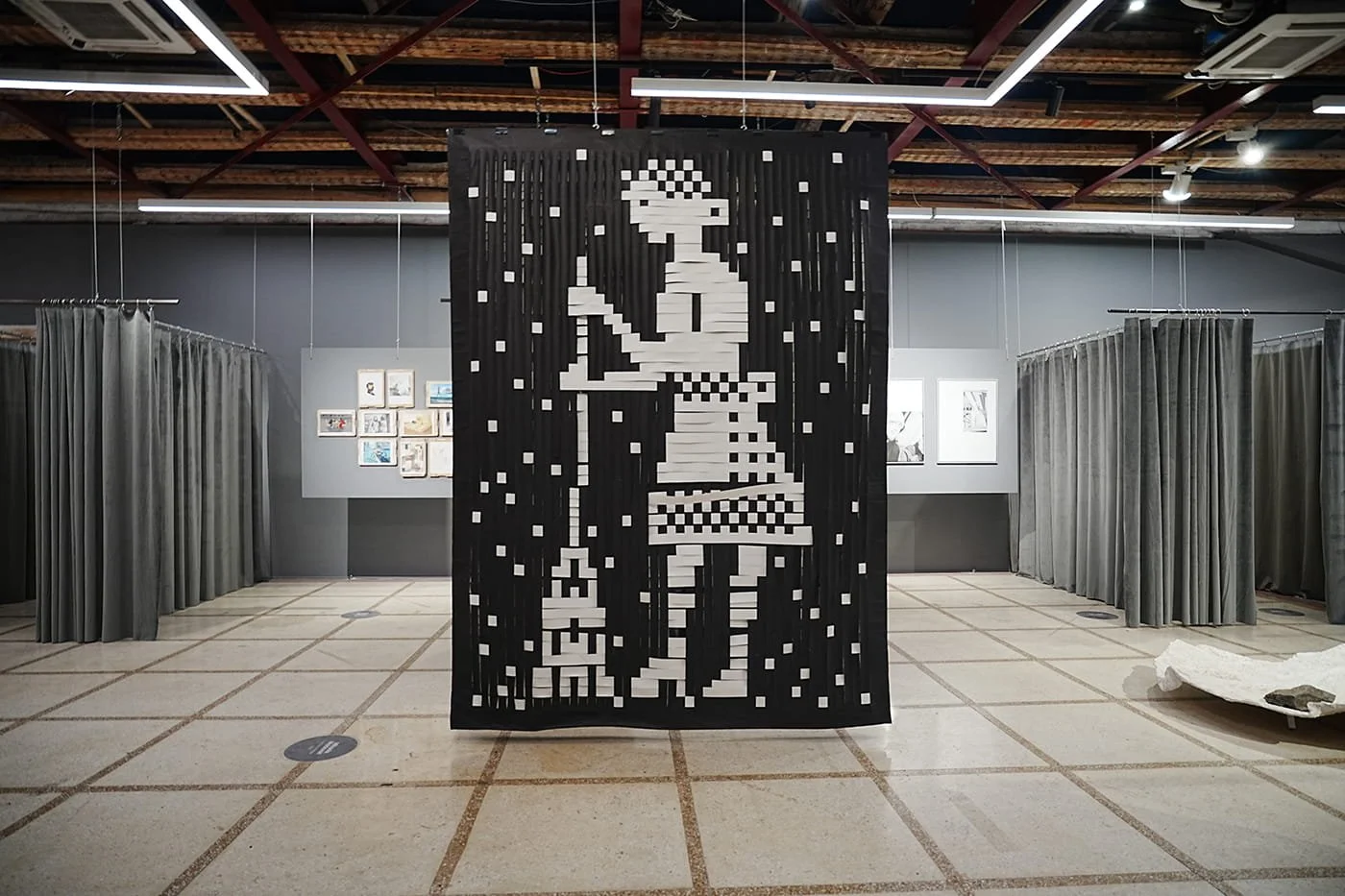
“Why we should all be feminists” is a non-exhaustive, depolarizing plea for a change in the way we respond to old dynamics and build new ones (individual, collective, governing, human-nonhuman, etc.), a shift towards a paradigm of equity, acceptance of diversity and differences, care and sustainability – which are more necessary today than ever before.
In 2012, Nigerian author and activist Chimamanda Ngozi Adichie gave her million-times-shared talk entitled “We Should All Be Feminists” at the TEDxEuston innovation conference in London, advocating for a fairer and more equal world for all people regardless of gender and cultural identity. It was a feminist manifesto that went around the world and promised great hope for the ongoing development of equality.
More than ten years later, in 2025, we seem to be experiencing an international backlash. Although much has been achieved in terms of legal equality for women, the reality of life is different. The international tradwife trend, as well as discussions about stay-at-home allowances in Austria, propagate a backward-looking worldview and thus oppose actual gender equality. In Austria, one in three women currently experiences violence and the number of femicides is alarmingly high compared to the EU average. Gender still influences social position, resources, rights, economic interests, and perspectives.
“Gender matters. Men and women experience the world differently. Gender colors the way we experience the world. But we can change that,” says Chimamanda Ngozi Adichie. Feminist artists have achieved a great deal in the fight for equality, but “THE ACHIEVEMENTS OF OUR GENERATION ARE FRAGILE,” warns Annegret Soltau, one of the most important feminist artists of the 1970s. She makes it clear that the achievements of the international feminist avant-garde formed in 1968 and IntAkt (International Action Group of Female Visual Artists), founded in Austria in 1977, must be reinforced and underpinned on a daily basis.
So, where do we stand today, almost 50 years after the IntAkt artists succeeded in questioning/challenging the mechanisms of power in society and gender relations? What kind of society are we longing for?
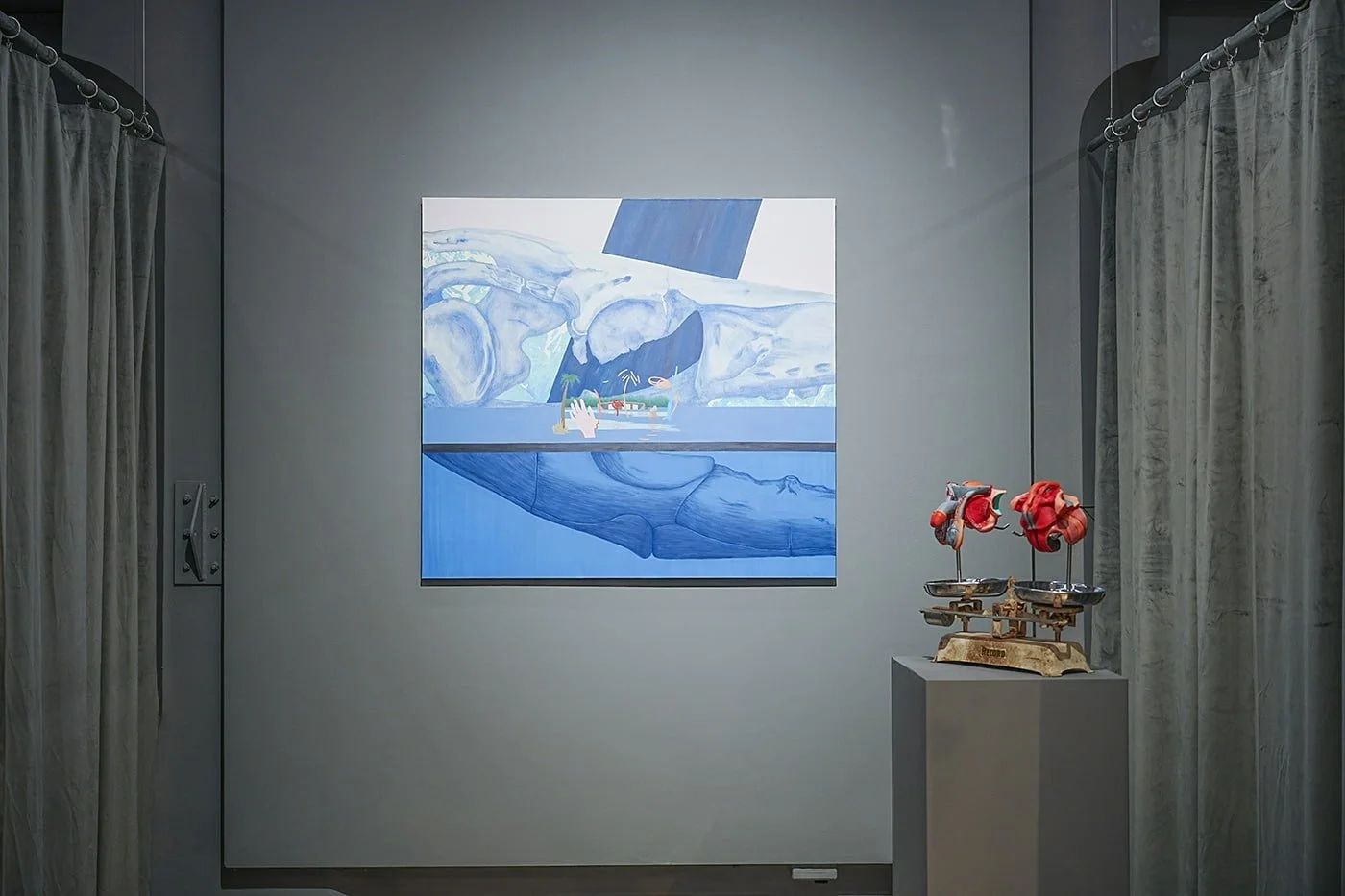
Endless
acrylic on canvas / 110 x 120 cm / 2021
The painting opens a space of reflection at the intersection of disappearance and continuity, between the succession of worlds and the role of the unconscious as an invisible force shaping our actions. The composition brings into juxtaposition and superimposition organic forms and planes of rigorous geometry that radically traverse the pictorial surface.
At the center of the work unfolds an apparently natural scene which, upon sustained viewing, reveals its carefully constructed character. It is a space of control and staging, projected against a background dominated by the presence of an oversized skeleton belonging to an extinct species, an echo and testimony to the worlds that came before us. There is a dialectical relationship between the visible and the hidden, between the surface and the sense of submersion, present in the lower plane of the work. The artificiality of the central scene may be seen as a meditation on the end of a world or species, mirrored by the disappearance evoked in the background.
As a counterbalance, the torso of a pregnant woman, the presence of a bird that seems to fly nostalgically toward the past, and the tender gesture of a hand resting on the cheek introduce the possibility of continuity and potential regeneration. They carry a sense of hope, suggesting that beyond disappearance, the promise of a new beginning remains perpetually open.
Fără sfârșit
acrilic pe pânză / 110 x 120 cm / 2021
Lucrarea deschide un spațiu de reflecție situat la intersecția dintre dispariție și continuitate, dintre succesiunea lumilor și rolul inconștientului ca forță invizibilă care influențează acțiunile noastre. Compoziția alătură și suprapune forme organice și linii drepte care formează planuri ce traversează și împart radical suprafața.
În centrul imaginii se conturează un cadru aparent firesc, o scenă care, pe măsură ce o privești, își dezvăluie caracterul atent construit, perfect regizat. Fundalul este dominat de scheletul supradimensionat al unei specii dispărute, ecou și mărturie a lumilor care au existat înaintea noastră. Există o relație dialectică între vizibil și ascuns, între suprafață și senzația de scufundare din planul inferior al lucrării. Artificialitatea scenei centrale poate fi văzută ca o meditație asupra sfârșitului unei lumi sau a unei specii, în oglindă cu dispariția evocată de fundal.
În contrapunct, torsul de femeie însărcinată, prezența păsării care pare să zboare nostalgic spre trecut și gestul tandru al palmei așezate pe obraz, introduc posibilitatea continuității și a potențialei regenerări. Ele oferă speranță, sugerând că, dincolo de dispariție, rămâne mereu deschisă promisiunea unui nou început.